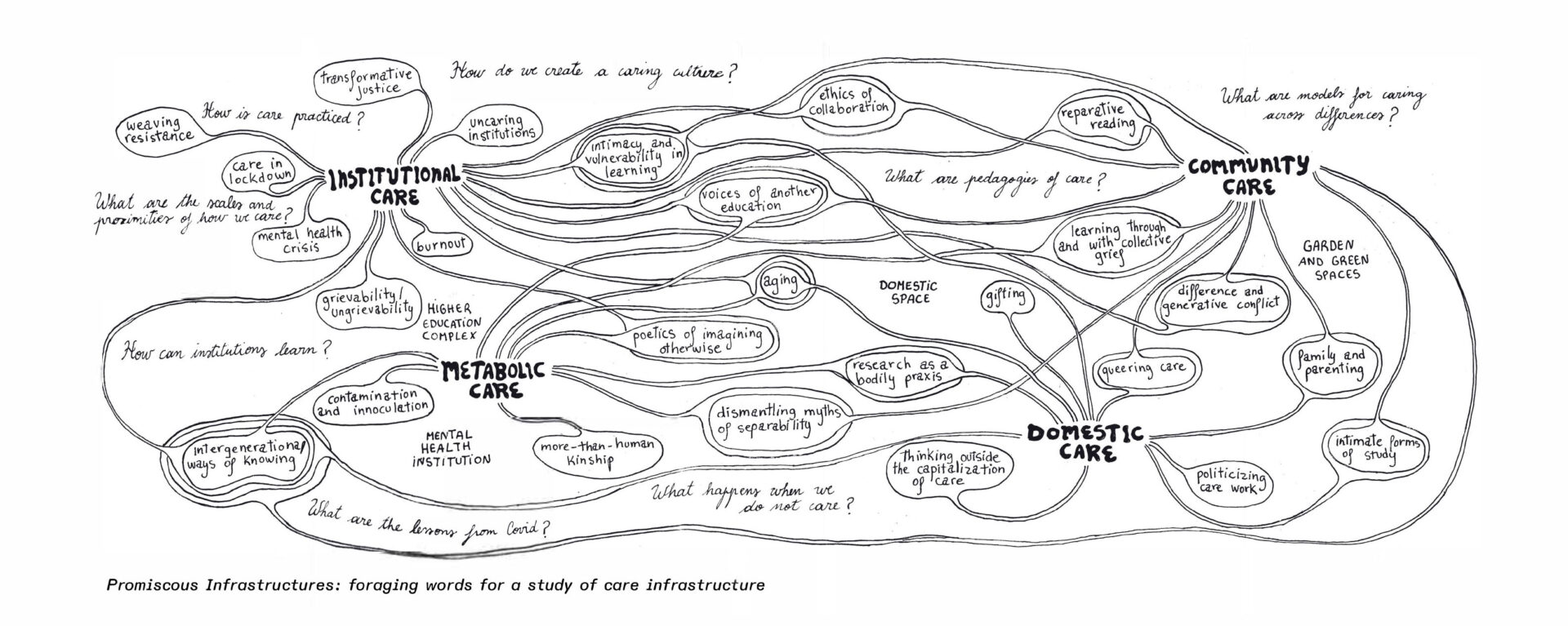
The Promiscuous Care Study Group emerged from the need to build up learning communities where we might recognize the abundance of working together in difference. Community care involves building relationships based on trust, understanding, and shared commitments while holding contradictory thoughts and feelings simultaneously. Or to quote bell hooks, it entails a form of acting that is “not assigned to the immediate social mythology of the status quo.”
According to the London-based “Care Collective,” “Promiscuous care means caring more and in ways that remain experimental and extensive by current standards. It means multiplying who we care for and how. Building on historical formations of ‘alternative’ care giving practices, we need to create the capacity for a more capacious notion of care […] To encourage promiscuous care means building institutions that are both capacious and agile enough to recognise and resource wider forms of care at the level of kinship.” (Care Collective: https://www.versobooks.com/blogs/4617-covid-19-pandemic-a-crisis-of-care)
We gather under the aegis of study, which encompasses the research and learning and sharing undertaken outside of the formal educational frameworks within which we work.
Study group members are: Carla Arcos, Seecum Cheung, Pablo Lerma, Judith Leijdekkers, Carmen José, Skye Maule-O’Brien, Vivian Sky Rehberg, Kari Robertson, Yusser al Obaidi, Michelle Teran, Renée Turner, and Julia Wilhelm
Animating Questions:
– Care in the Institution: How to take care of each other and create a web of support? How can the academy cultivate an environment of community care to meet the challenges of our times and to nurture future generations?
– Community agreements, practices of consent: What are the practices of working together in difference within divergent modes of thinking and acting? Are there examples within physical and online communities that we might learn from?
– Generative conflict: How can conflict be generative, and disagreement not mean failure? What are models for caring across differences?
– Practices of communal responsibility and individual accountability: How could accountability, reparations, and healing look in our learning communities?
– Transformative vs. transactional relationships: How can we build up relationships internally and externally that are based on trust, understanding, and shared commitment which honours the space to share in each other’s skills, experiences, and knowledges.
– Decoloniality as a practice: How do we engage in rethinking notions of power that do not replicate domination and oppression? How do we use what is already there to find other ways to speak?
– Pedagogy of Attunement: What are the pedagogies of care as learning, deep listening, and tending to? What are the connections between what is inside the classroom and what is outside of the classroom and vice versa? Who takes care of our classrooms when we are not there, who prepares the space and makes our classes possible, but are invisible?
How is care practiced? What are the nuances of care? What are the limits to care? What happens when we do not care?
Activities
– Bi-weekly meetings
– Activities and particular focus areas will develop according to individual needs and interests, with openness to simultaneously holding contradictory thoughts and feelings
– Practice workshops on building trust and safety, abolitionist pedagogies, etc.
– Mapping an Etymology of Care.
– Collective writing and transcribing.
– Hosting and guesting (guests can be people, artefacts, texts, artworks, etc.)
– Reading, watching, listening, experiencing, screening, cooking and eating together.
Research Outputs
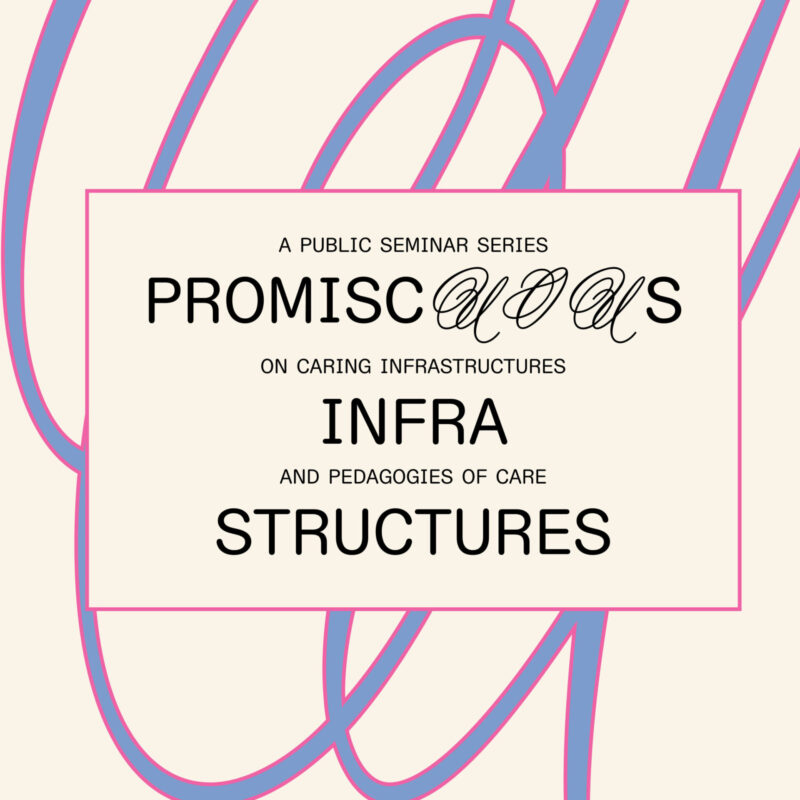
Promiscuous Infrastructures Seminar Series 2023
A public seminar series of caring infrastructures and pedagogies of care
Workshops, lectures, conversations and interventions by Selma Bellal, Yoeri Guépin, Edwin Mingard, Lola Olufemi, and Laurence Rassel
Partners: Reading Room Rotterdam, TENT and WdKA Research Center

Promiscuous Infrastructures. Practicing Care
Michelle Teran, Marc Herbst, Vivian Sky Rehberg, Renée Turner, and The Promiscuous Care Study Group (eds.)
The Journal of Aesthetics & Protest, WdKA Research Center
20249798218366827
Softcover
19.5 x 14.5 x 2 cm
288 pages with 82 color pages
Exposed spine binding. Language: English.
First Edition 2024. Second Edition 2025.
With contributions from:
Carla Arcos, Jacquill G. Basdew, Selma Bellal, Seecum Cheung, Cooking Something Up, Yoeri Guépin, Marc Herbst, Czar Kristoff P., Pablo Lerma, Judith Leijdekkers, Carmen José, Edwin Mingard, Skye Maule-O’Brien, Lola Olufemi, Laurence Rassel, Vivian Sky Rehberg, Reading Room Rotterdam, Kari Robertson, Yusser al Obaidi, Michelle Teran, Renée Turner, and Julia Wilhelm
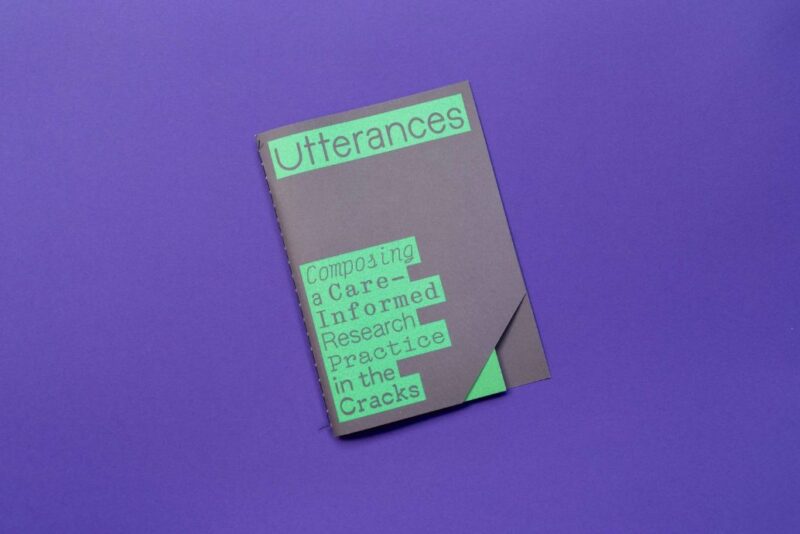
Utterances: Composing a Care-Informed Research Practice in the Cracks
by The Promiscuous Care Study Group
Co-publishers HumdrumPress, Meteoro Editions and Research Centre Willem de Kooning Academy
Cover size of 140x195mm
Inside size of 110x155mm
60 page,
Edition of 500
ISBN 978-90-83423-10-4,